
Fire Is Not the Crisis. Logging Bills Called Wildfire Bills Are.
How Congress uses fire panic to open public lands to extraction — and why the left keeps letting it happen.
We live on a fire planet. Not a western fire planet, not a climate-change fire planet, but a fire planet — one whose forests, grasslands, shrublands, and savannas evolved with fire since time immemorial across every region of this country. Longleaf pine communities in the Southeast. Oak woodlands in the Midwest. Pitch pine barrens in the Northeast. Ponderosa pine forests across the Intermountain West. These ecosystems do not merely tolerate fire. They depend on it: to recycle nutrients, generate structural complexity, and maintain the conditions that support the biodiversity we claim to value. Fire and other natural disturbances moving through these landscapes on their own terms is not destruction. It is the process by which they persist, succession. That is not a climate story. It is an ecological reality that predates the current crisis by millennia, and it is practically absent from the legislative debate happening in Washington.
This week, the Senate Energy and Natural Resources Committee voted to advance S. 140, the Wildfire Prevention Act, with a last-minute amendment codifying the repeal of the Roadless Rule, fifty-eight million acres of national forest theoretically protected from road construction since 2001. The response across public lands media was swift: Republicans had hijacked a good bipartisan bill. Senators Heinrich and Wyden held a press conference. Outdoor influencers rang the alarm.
The framing is wrong, and it matters that it is wrong.
S. 140 was not a wildfire bill before the Roadless Rule amendment. It is a logging acceleration package. It mandates logging targets scaled to forty percent above historical baseline by 2029. It raises the timber sale threshold in ways that expand commercial harvest authority. It requires agencies to use streamlined environmental review on any unit containing high-risk land, not as a discretionary option, but as a mandate. And it creates categorical exclusions for what it calls “high-priority hazard trees,” bypassing environmental review on removal projects up to three thousand acres. The bill also authorizes treatment wherever insects or disease may kill twenty-five percent of standing trees over fifteen years. May. Future tense. Probabilistic. That is not a damage threshold. It is a description of how forests work. Insects, disease, and fire are not threats to these ecosystems. They are the processes that constitute them. When legislation classifies succession as a hazard requiring remediation, it is not protecting forests. It is criminalizing them.
The Roadless Rule repeal is the most visible provision. It is not the only damaging one. Mobilizing to strip the amendment and resurrect the prior bill is not a conservation win. It is a defense of a logging mandate with better branding.
The carbon math is not ambiguous. Harris et al. (2016) found that forest management emits roughly ten times more carbon than fire and beetle outbreaks combined. Intact forests, their soils, mycorrhizal networks, snag fields, seed banks, and hydrological systems, regulate temperature, retain moisture, and cycle carbon at landscape scale. They have been doing this work since time immemorial without a management plan. The Forest Service sits under the United States Department of Agriculture. It was built to see these ecosystems as crops. Legislating faster harvest rates in the name of fire safety does not change what that is. It accelerates it.
The most damning number from yesterday’s press conference did not come from the fire statistics. It came from Trout Unlimited president Chris Wood, one of the architects of the original Roadless Rule: roadless areas represent two percent of the American landscape, and twenty-five percent of all threatened and endangered species depend on them for habitat. A quarter of this country’s most imperiled wildlife has been crowded into two percent of the land. That is not an argument for protecting roadless areas. It is an indictment of what has been done to the other ninety-eight percent, a measure of how thoroughly the commodity-crop model of public lands management has hollowed out the ecological fabric of this country, leaving the most biodiverse, structurally complex, hydrologically intact landscapes as isolated refugia in a landscape organized around extraction.
The press conference data intended to defend those areas actually reveals the problem. Thirty-four percent of all Forest Service treatments have occurred in roadless areas, which represent only twenty-one percent of the forested national forest landscape. These are not protected landscapes. They are the most intensively managed landscapes we have left. Senator Heinrich called this evidence of flexibility: do the work, pull the road out when you’re done. But removing a road does not restore what was removed before it. The logs are gone. The centuries of structural complexity that created the habitat, the carbon storage, the hydrological function, do not return because the access point was decommissioned. A roadless area that has been logged and de-roaded is not a roadless area. It is a logged area without a road. The question the flexibility framing never asks is why these self-regulating landscapes require human intervention at all. The Roadless Rule’s defenders have drawn a line and called it protection. It is just marking where the extraction hasn’t gotten yet.
Senator Jim Risch of Idaho offered what he intended as reassurance at the committee markup: that when you sit down at the table, there is very little daylight between Republicans and Democrats on forest management. He is right. That is precisely the problem. Bipartisan agreement on public lands has consistently meant both parties accepting the premise that national forests require active management to remain ecologically functional, a premise the timber industry has spent decades embedding in agency culture, budget structures, and now legislation. It is the premise that produced the ninety-eight percent. Bipartisan is not a synonym for correct. On forest policy, it has too often been a synonym for shared capture.
Senator Wyden’s press conference remarks leaned heavily on the value of bipartisanship, on good work begetting more good work. But Republicans have made clear, repeatedly and without apology, that they are not interested in what the public wants on this question. When the Roadless Rule was established, one point six million Americans submitted comments, ninety-five percent in support. In the current effort to repeal it, ninety-nine percent of comments oppose repeal. Republicans are advancing the repeal anyway. Calling for bipartisanship in that environment is not a strategy for protecting public lands. It is a framework that keeps Democrats negotiating over the terms of extraction rather than contesting extraction itself.
Democratic senators cannot continue lending credibility to the wildfire-as-extraction framework and then express surprise when that framework is used to extract. Every time a Democrat praises the underlying bill, cites its bipartisan credentials, or treats the Roadless Rule repeal as the only problem in the room, they provide institutional cover for a policy direction that degrades the ecosystems that regulate our climate and does nothing meaningful to protect the communities fire actually threatens. Where is the outrage over the initial bill? The Roadless Rule amendment has generated press conferences, activist notes, and senatorial hand-wringing. The mandatory logging targets, the insect mortality provisions, the categorical exclusions, the streamlined review mandates, the machinery that will do the loud, durable damage, have generated almost nothing. That asymmetry is not accidental. It is how the framework protects itself.
The progressive tendency to frame every large fire as a symptom of climate chaos, and to treat anyone who complicates that narrative as insufficiently alarmed, has made it nearly impossible to have an honest conversation about fire ecology. Fire is not a pathology. It is succession. The crisis is not that fire exists on a fire planet. It is that we built communities in fire-adapted landscapes without accounting for what that means, and have spent decades doubling down on tactics that fail those communities while the structures they live in remain unaddressed.
Roughly forty percent of the American population lives within or adjacent to the wildland-urban interface. The most destructive fires in recent years have not been deep-forest events. They have been grassland and chaparral fires, the January 2025 Los Angeles fires being the most recent and visceral example, driven by ember transport across landscapes where communities were built without accounting for the fire regimes those ecosystems have always carried. Embers do not respect fuel breaks, treatment units, or property lines. The dominant approach to fire management, increasingly rebranded with more palatable language but unchanged in its extraction-forward logic, is not failing for lack of scale. It is failing because no amount of logging controls wind, drought, or the speed at which an ember travels, while the structures people live in remain unaddressed.
The legislative answer already exists. S. 3609 and HR 582, the Community Protection and Wildfire Resilience Act, direct investment where the evidence points: community preparedness and home hardening in the wildland-urban interface. The science is clear on which intervention protects communities and which one does not. These bills require accepting that people living in fire-adapted landscapes need fire-resistant infrastructure, honest information about risk, and resources to act on it, not a logging mandate dressed in the language of prevention.
This is not a do-nothing position. These landscapes are not doing nothing. They are processing carbon, building soil, creating habitat, recharging aquifers, and regulating the temperature and moisture conditions that make them function. The work that actually needs doing, hardening structures, retrofitting communities, defensible space pruning around homes, is in S. 3609 and HR 582. It is not in this bill.
The Roadless Rule repeal should be opposed. But the rule in its current form is not the destination. These landscapes need stronger protection, not more flexible management. The loopholes that have allowed thirty-four percent of Forest Service treatments to occur inside roadless areas should be closed, not defended. Mother nature has been doing this work since time immemorial. The correct policy response is to stop interrupting her.
The bill should be opposed. The framework that produced it should be opposed. And the next time Congress calls a logging bill a wildfire bill, we should know better than to mourn the bipartisanship when it falls apart.
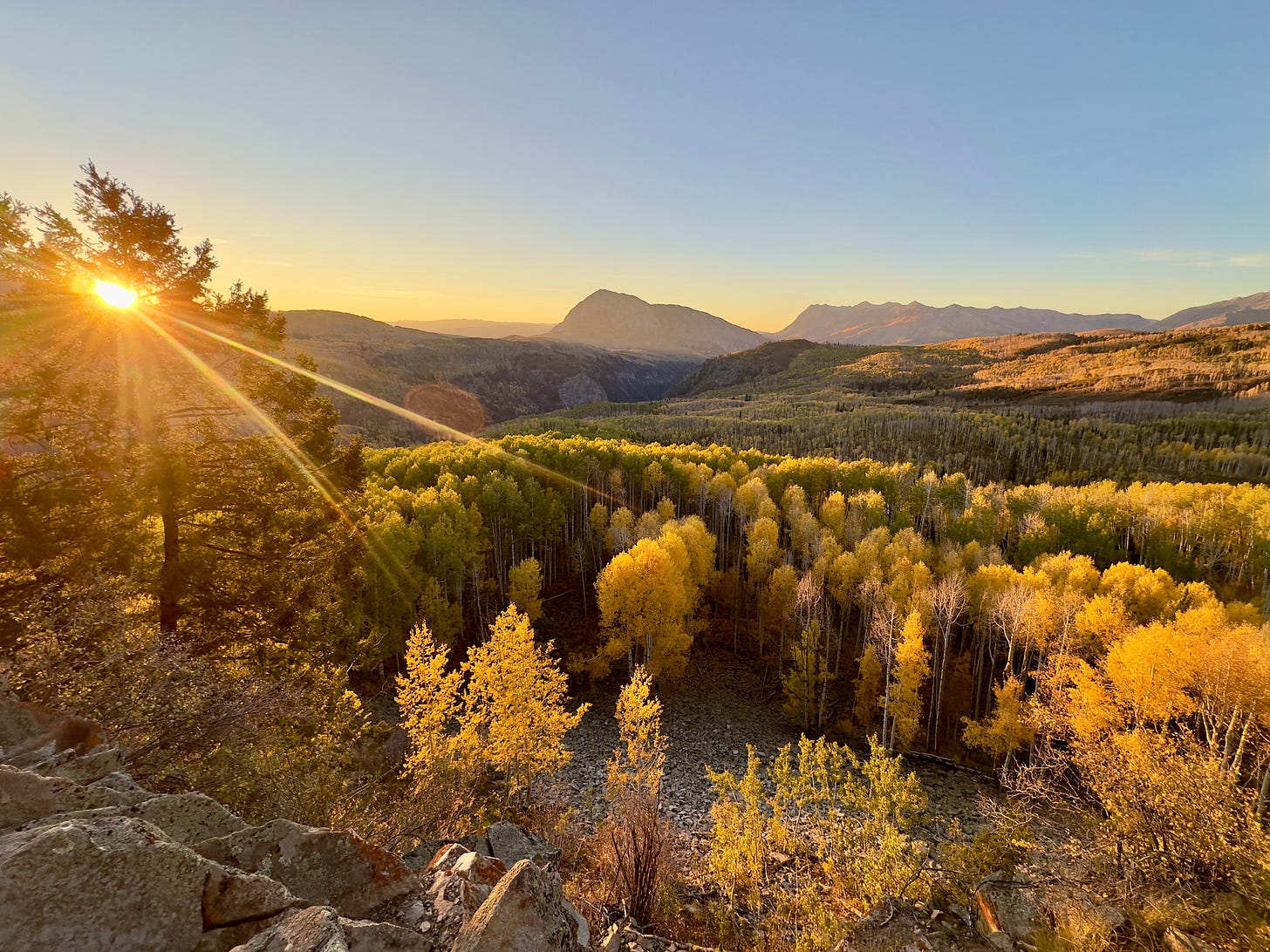
Horse Ranch Park Roadless Area, Crested Butte, Colorado, looking toward the Raggeds Wilderness. October 2024. © Nick Scrithfield