
Stop Celebrating the Loophole
“Flatulence is just another word for fart, and they both stink.” — Ted Lasso
This administration is trying to gut the Roadless Rule, and that fight is real. But the mainstream pushback is uninspiring. Citing that thirty-four percent of Forest Service “treatment” activity happened inside roadless areas, as groups have this Congress, isn’t a defense of these forests. It’s proof the loophole already lets a lot through, offered up like a selling point instead of the problem it is. That loophole permits cutting “generally small diameter timber,” a phrase the rule never defines. The Forest Service has already used that undefined language in court to justify cutting trees up to 21 inches in diameter, reasoning they’re “small” relative to how large the species could theoretically grow, not small by any ordinary measure. A phrase vague enough to cover a 21-inch tree isn’t a safeguard. It’s an opening. Congress should close it if it codifies the rule, not codify the rule as it stands, loophole intact.
None of this is new to us, even if it’s still a fringe position inside this movement. Some of us have been making this argument for years, from outside the rooms where the legacy groups set strategy, not against the goal of protecting these forests, but against the terms they’ve settled for. Close the loophole. Stop treating “treatment” as neutral. We were told, repeatedly, that now wasn’t the time, by people whose access depends on staying inside acceptable vocabulary. Being on the fringe doesn’t make the argument wrong. It just means the people it threatens have had an easier time ignoring it.
Touting the loophole doesn’t fix the underlying problem. It just extends the smokescreen that nature is something we can manage into submission, an odd premise to keep leaning on when mechanical treatment emits roughly ten times more carbon than fire and native insects combined. Even in a large, intense wildfire, only about 2 to 3 percent of the carbon in trees is actually consumed. The rest stays on site, as standing snags, downed wood, and soil, feeding the next generation of forest, assuming it’s given the chance. “Treatments” remove carbon outright, and the microclimate it leaves behind, hotter, drier, windier, makes what’s left more likely to burn severely too.
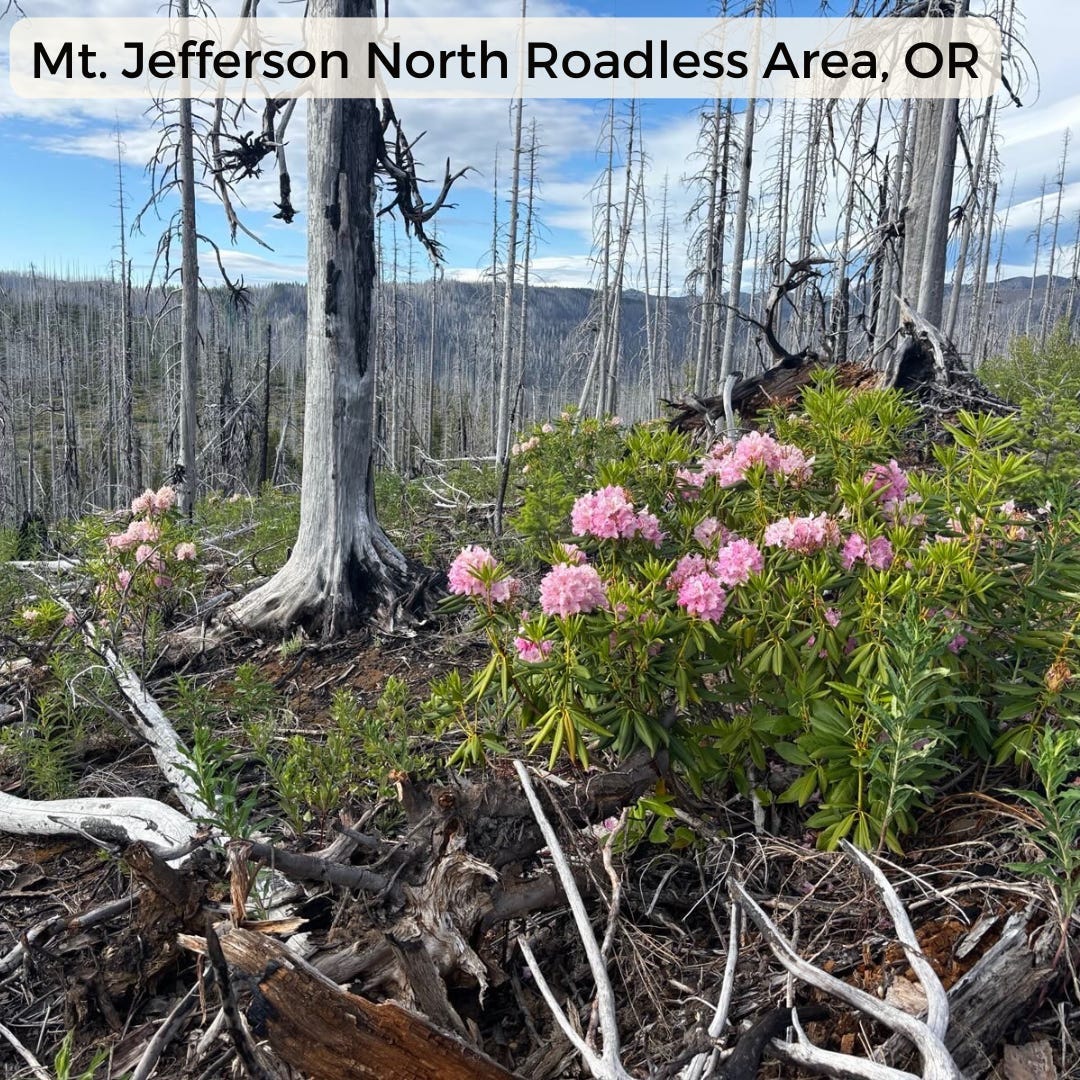
Mixed and high-severity fire moved through these forests long before colonization too, opening canopy, resetting soil, building the exact structural complexity species depend on.
Weather, not the vegetation on the ground, mostly decides whether a fire becomes an extreme, fast-moving event. Drought, wind, and heat drive that far more than what’s standing in its path, and as climate whiplash intensifies, there will be more fast fires, not less, regardless of how many acres get “treated.” What logging changes isn’t the weather. It’s what’s left behind for that weather to burn through: a hotter, drier, more open stand instead of an intact one. That’s why removing more trees correlates with higher severity, not lower: the mechanism is a degraded microclimate, not a fuel load that “treatments” claim to fix. Weather can’t be managed. A fire-adapted forest, built by exactly this kind of disturbance, doesn’t need to be either.
If anyone serious about climate still lets “hazard treatments” leave their lips as a solution, that’s a form of denial too. It treats these forests as if natural disturbance were an aberration instead of what they’ve evolved with since time immemorial, and it ignores that attempting to manage that disturbance away burns more carbon than the disturbance itself, even when that’s not obvious to most people watching the news. That’s on us to fix. They haven’t done the work of teaching people that a burned landscape in early succession is something to protect, not something to grieve. There are two real goals here, not one. Protect these lands and the natural disturbances that sustain them, fire, insects, all of it. And build fire-adapted communities from the home outward, hardened structures, defensible space, better evacuation routes, smoke centers, real investment in the places people actually live. We already have both solutions. What’s missing isn’t science or money. It’s the willpower in Washington to put actual dollars behind them rather than another round of stale buzzwords dressed up as caution.
Mainstream groups’ talking point is specific: “treatments” are already allowed under the current rule, since it only bars new roads and industrial logging, and 34% of Forest Service fuel treatment activity between 2001 and 2019 already happened in roadless areas. Senator Heinrich called this flexibility itself the selling point at a press conference this summer, describing the rule’s build-a-road-then-remove-it provision as “the most flexible conservation tool that we have.” That’s not a defense of roadless areas. It’s a description of how easily the loophole gets used, dressed up as praise. And it undercuts something these same groups say elsewhere, that roadless areas are among the last intact forests in the country. A landscape where a third of all national “treatment” activity has already occurred isn’t intact by any definition. It’s evidence the loophole has been doing exactly what a loophole does.
The independent record doesn’t support treating fuels reduction as neutral, and neither does the Forest Service’s own science. Bradley et al 2016 analyzed roughly 1,500 fires and found the more trees removed through logging, the higher the fire severity, not lower. Calkin et al 2023 concluded that wildland-urban fire disasters aren’t actually a wildfire problem, they’re a home-ignition problem, and the real fix is hardening the roughly 100 feet immediately around a structure, not treating forest miles away. A true public lands champion doesn’t cite a treatment statistic as a selling point. They ask what it’s actually buying, and stop repeating it once they know.
To be clear, we do not support the rescission. It’s a bad-faith attack dressed up as wildfire policy, and it should be opposed. But opposing it doesn’t mean celebrating the talking points Democrats and mainstream groups have chosen to oppose it with. USDA’s own release makes the administration’s actual argument plain: roads for “access,” natural disturbance reframed as tinderbox, all wrapped in the language of “treatments”. That argument deserves a direct rebuttal, not a softer version of its premise. Stop calling it flexibility. Say what it is, and then close the loophole, not codify it.
The public comment period opens tomorrow and runs through midnight, September 21. When it does, submit yours through Regulations.gov under docket FS-2025-0001. Then tell your members of Congress what the actual ask is: not a restored rule with the same hole in it, but closing the loopholes. Or even better: every Inventoried Roadless Area converted to designated Wilderness. Full stop.
© Adam Bronstein