
Fire Management Is the Story. Logging Is What’s Happening.
The equipment doesn’t wait for the science to catch up.
Note: Before we get into what we found on the ground on our most recent trip to the sequoia groves, let us be direct about something we keep having to say in comment sections: the decision to log in Mariposa Giant Sequoia Grove in Yosemite National Park was made under the Biden administration. The actual cutting happened under Trump. Both are culpable. This is not a reason for complacency about the current administration, which is indeed in full-destruction mode with practically everything. It is a reason to understand that the management-in-the-name-of-fire playbook is thoroughly bipartisan, has been running for decades, and will continue to run through whatever administration follows this one unless we name it for what it is and stop it. The outrage is warranted. The tunnel vision is not.
We just returned from another round of visits to the giant sequoia groves of the southern Sierra Nevada, and we came back with field observations from four sites and two new studies that dismantle nearly everything the agencies have been telling the public about sequoias, fire, and what these forests actually need.
Here is what we saw.
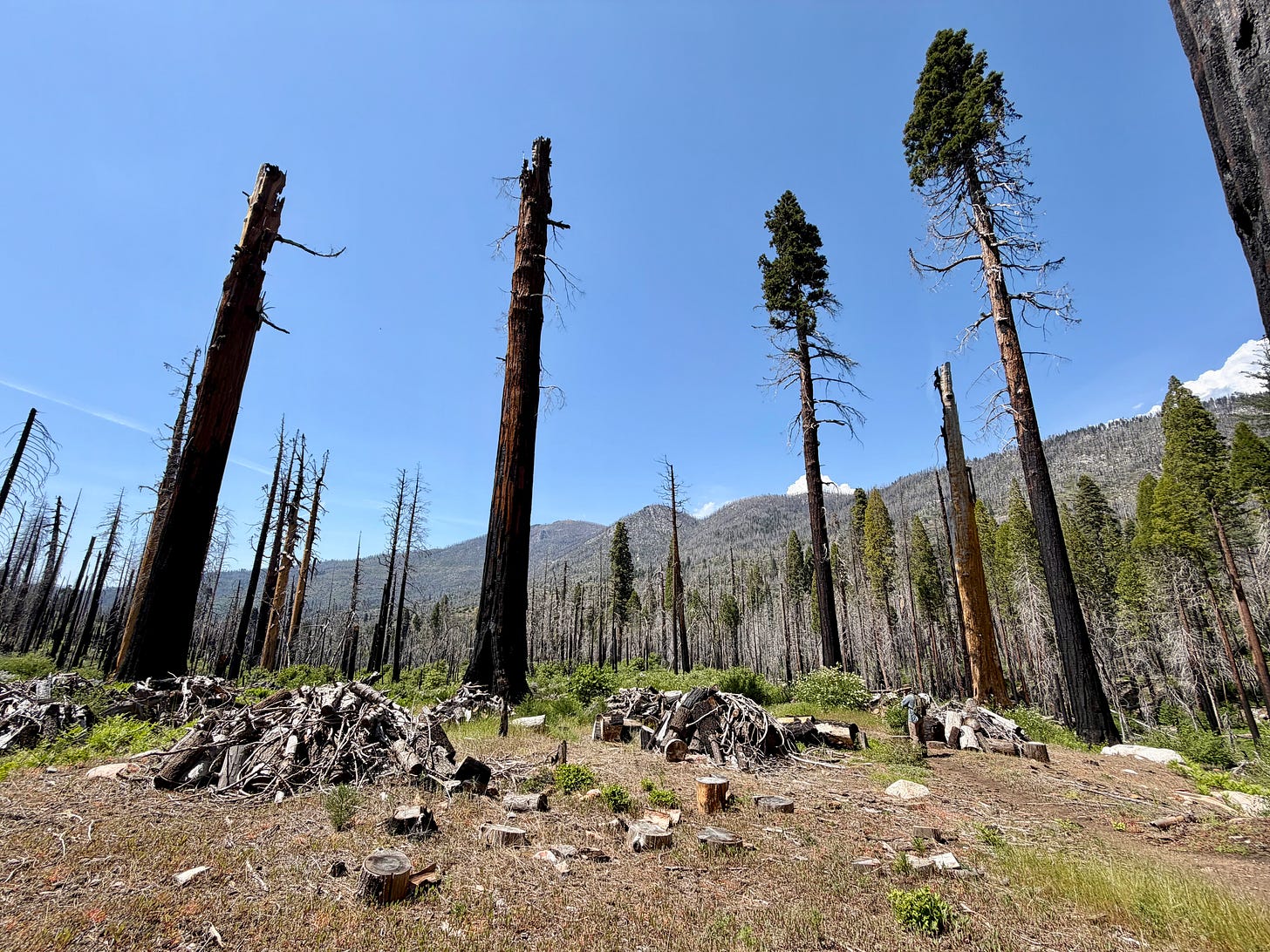
Mariposa Grove, Yosemite National Park — Cuts made in the name of fire mitigation, no public notice or environmental analysis. Pay attention to the institutional detail here, because it matters: this is the National Park Service, not the Forest Service. Different agency, different political constituency, different legal framework. When the same justifications — fire risk, forest health, proactive management — travel seamlessly across agency lines and across administrations, you are not looking at a rogue bureaucracy or a rogue presidency. You are looking at a story that the logging industry and the land management-industrial complex has successfully sold to everyone willing to buy it. The cover works because we have built a political culture in which doing something about fire is automatically preferable to letting fire do what fire does. And the work doesn’t wait for legislation. Emergency administrative orders are already authorizing this on the ground — in groves, in parks, across public lands — while the “Fix Our Forests Act” and the “Save Our Sequoias Act” logging bills work their way through Congress. Litigation is currently the thin line between these places and the equipment. That is the situation as it stands.
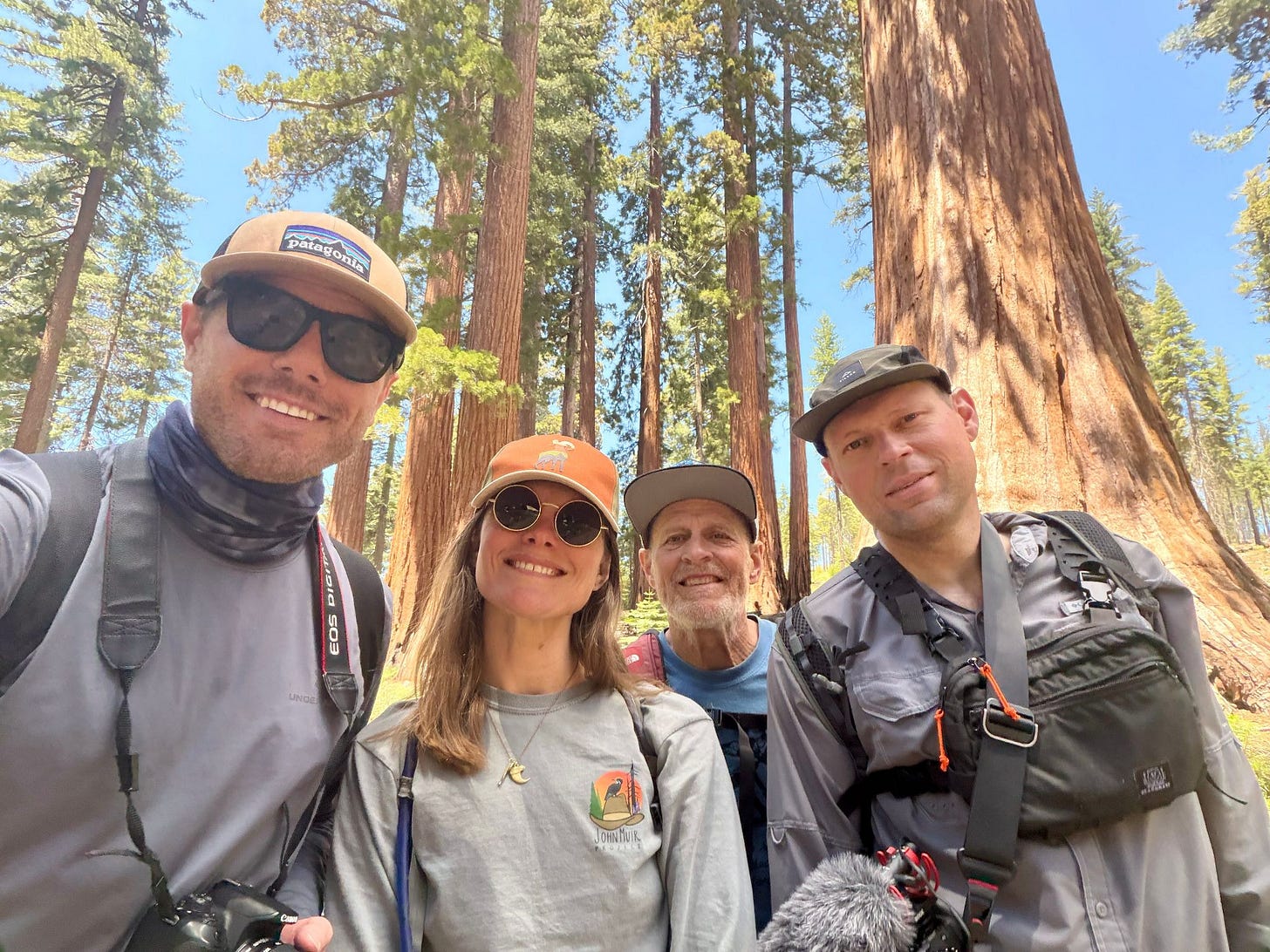
Mariposa Grove (Crew!), Yosemite National Park, May 2026 © Nick Scritchfield
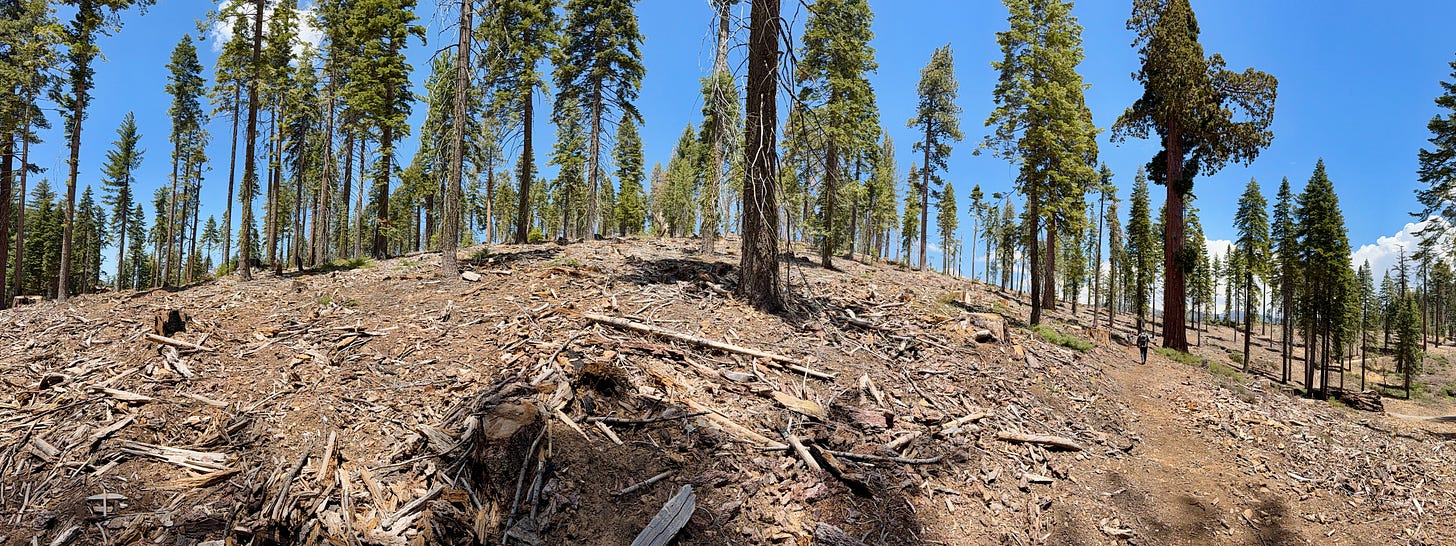
Logging and wood chips in Mariposa Grove, Yosemite National Park, May 2026 © Nick Scritchfield
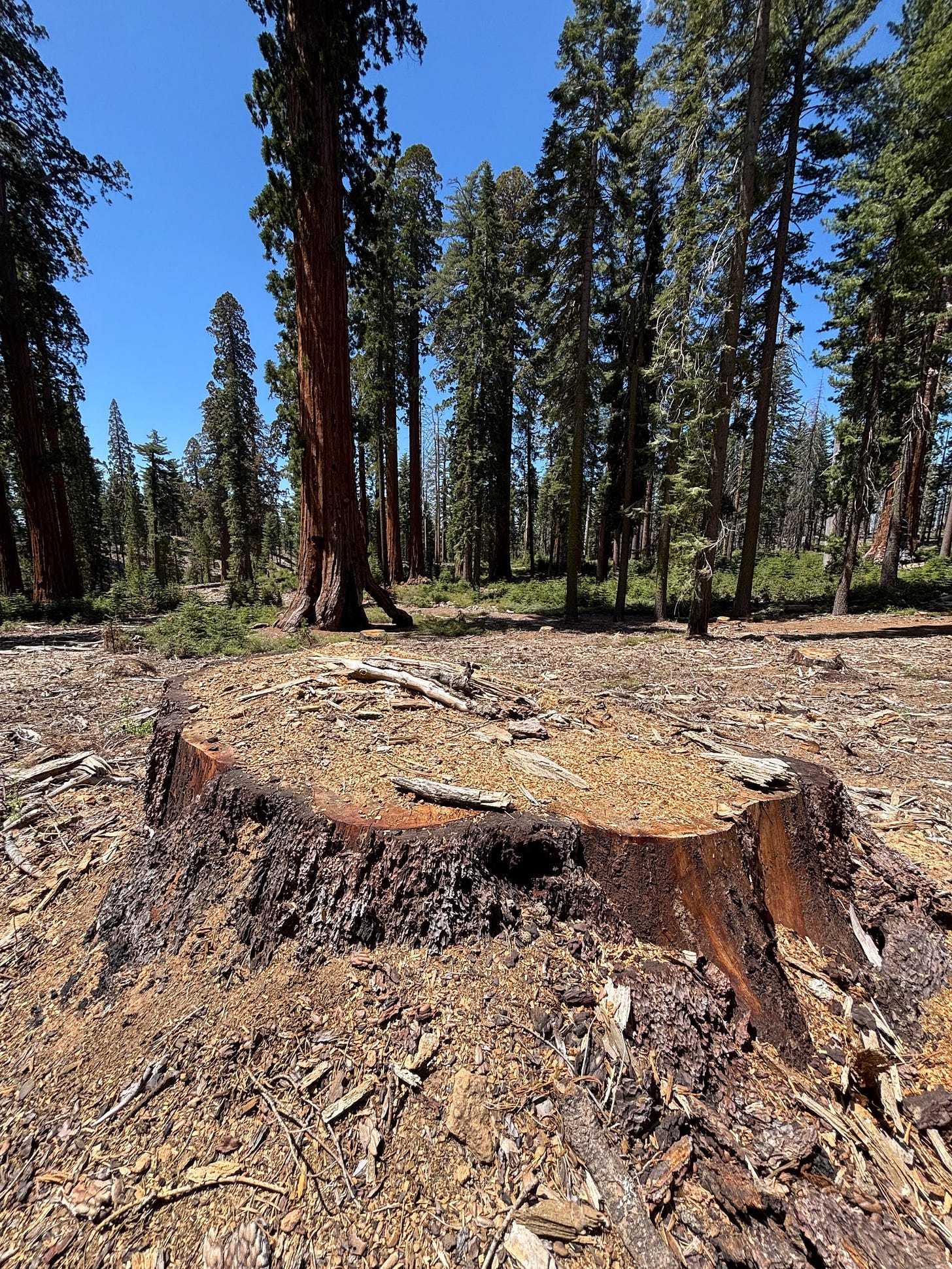
Logging and wood chips in Mariposa Grove, Yosemite National Park, May 2026 © Adam Bronstein
This is also a good moment to address a question that comes up in these conversations: but they didn’t cut sequoias, so where’s the harm? The other conifers being cut are part of the sequoia grove ecosystem. They are the same forest. In fact, most of the trees in a mature giant sequoia grove are other species, like cedar, fir, and pine. They all matter, live and dead. In fact, dead trees — including beetle-killed trees, which people often assume are the obvious candidates for removal — are wildlife habitat, soil anchors, and carbon stores. And when heavy equipment rolls through to extract them, it crushes the naturally regenerating sequoia seedlings that are already doing exactly what the agencies claim they are trying to encourage. The smokescreen is not just about which species gets cut. It is about what the machinery does to everything else on its way in and out.
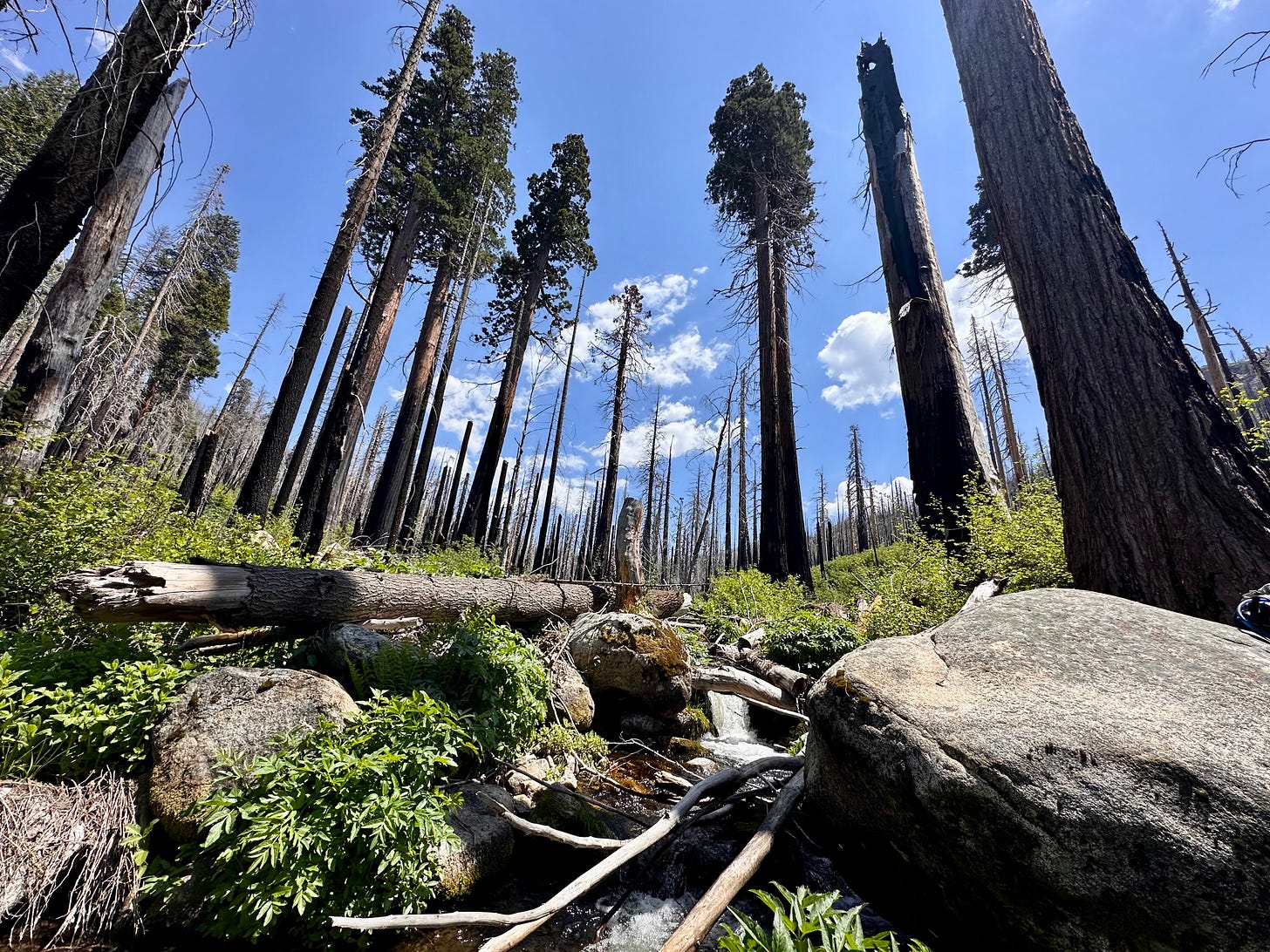
Redwood Mountain Grove, Sequoia Kings Canyon National Park — Finally open to the public, and you should go. Burned in the 2021 KNP Complex Fire. It is regenerating not despite the high-intensity fire but because of it. The densest, most vigorous sequoia regeneration we observed was in the areas that burned the hottest. Many thousands, and sometimes tens of thousands, of naturally regenerating seedlings and saplings per acre. The planted seedlings, by contrast, were mostly dying — isolated, struggling, a living rebuttal to the assumption that sequoias need our help getting started, when they demonstrably do not.
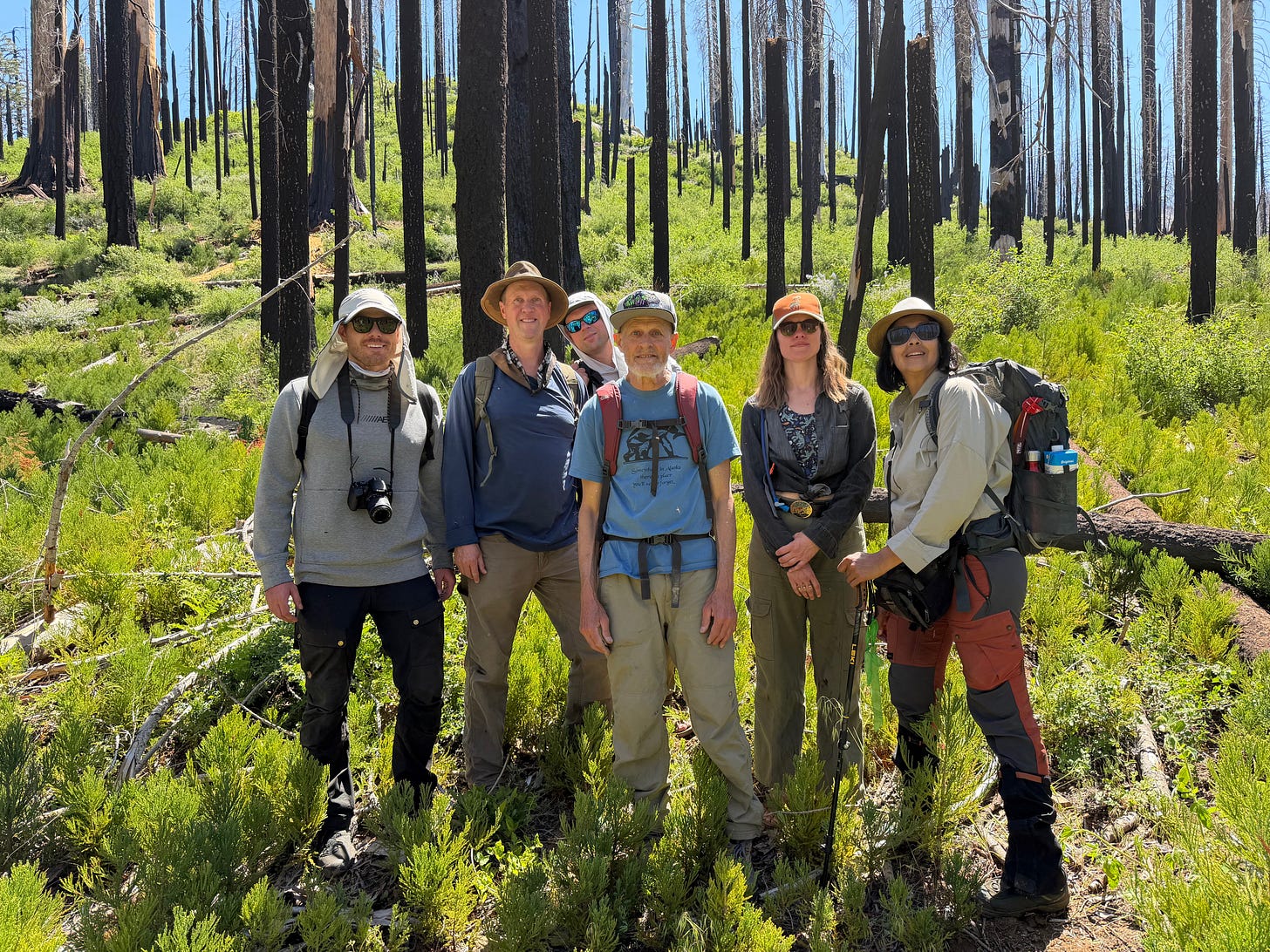
Redwood Mountain Grove (Crew!), Sequoia & Kings Canyon National Park, May 2026 © August Pohl
Belknap Grove, Giant Sequoia National Monument — Logged and piled. The stated rationale is always fire risk reduction. What logging and slash pile accumulation actually produce is increased flammability. And those piles are an industrial artifact, not an ecological one. When they are ignited — with accelerant, in place, at a single point of concentrated heat — the result has nothing in common with the mixed-intensity fire these forests evolved with. It cooks for days and weeks in the same place. It sterilizes soil. It volatilizes stored carbon. It produces, deliberately, the kind of damage the agencies attribute to the fires they claim to fear. The exposed soil left behind is erosion waiting for rain. The disrupted canopy changes moisture dynamics in ways that make the remaining forest more vulnerable, not less. The intervention worsens the problem it claims to solve.
Belknap Grove, Giant Sequoia National Monument, May 2026 © Jennifer Mamola
Logging, piling and crushed baby giant sequoias in Belknap Grove, Giant Sequoia National Monument, May 2026 © Nick Scritchfield
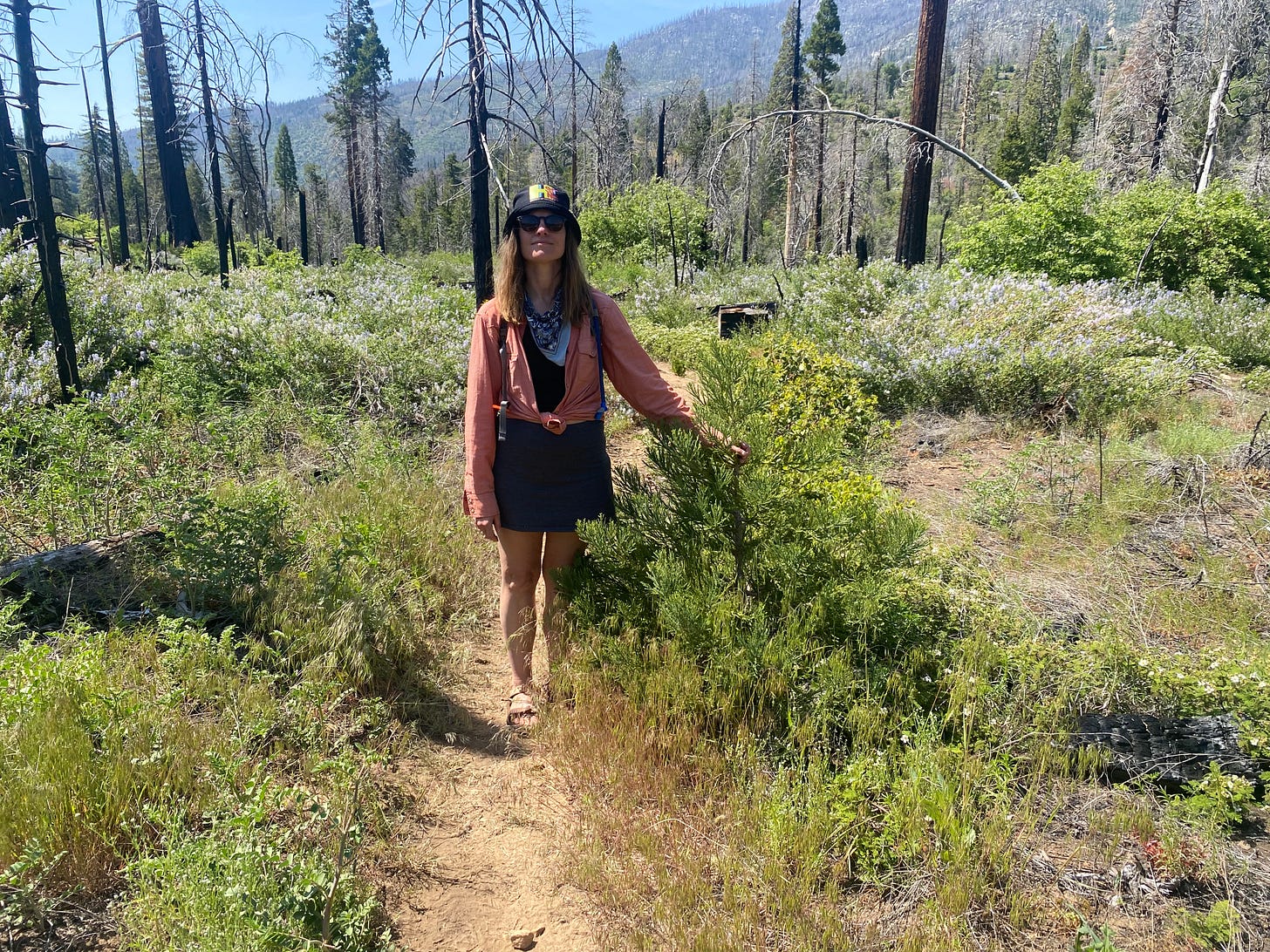
A naturally regenerating giant sequoia seedling in Belknap Grove, Giant Sequoia National Monument, May 2026 © Jeff Juel
Freeman Creek Grove — The baby sequoias we documented last year are now eight, ten, twelve feet tall and still climbing in the big high-intensity fire patch. Natural regeneration in this large crown fire patch is doing exactly what it does. In the areas where management intervened — where equipment came through and seedlings were crushed under the notion that the grove needed tending — the contrast is not subtle.
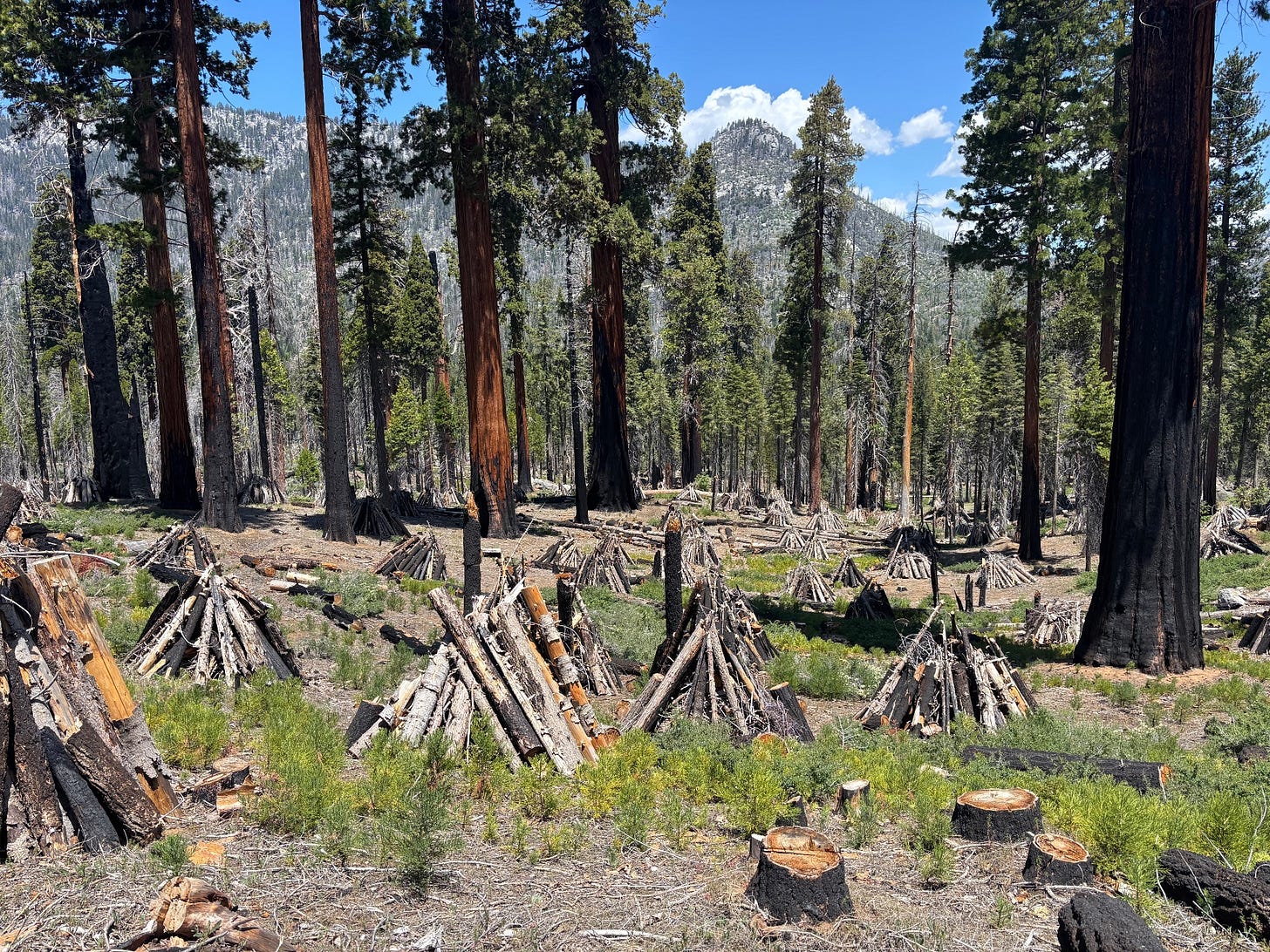
Logging, piling and crushed baby giant sequoias amongst the natural regeneration in Freeman Creek Grove, Giant Sequoia National Monument, May 2026 © Adam Bronstein
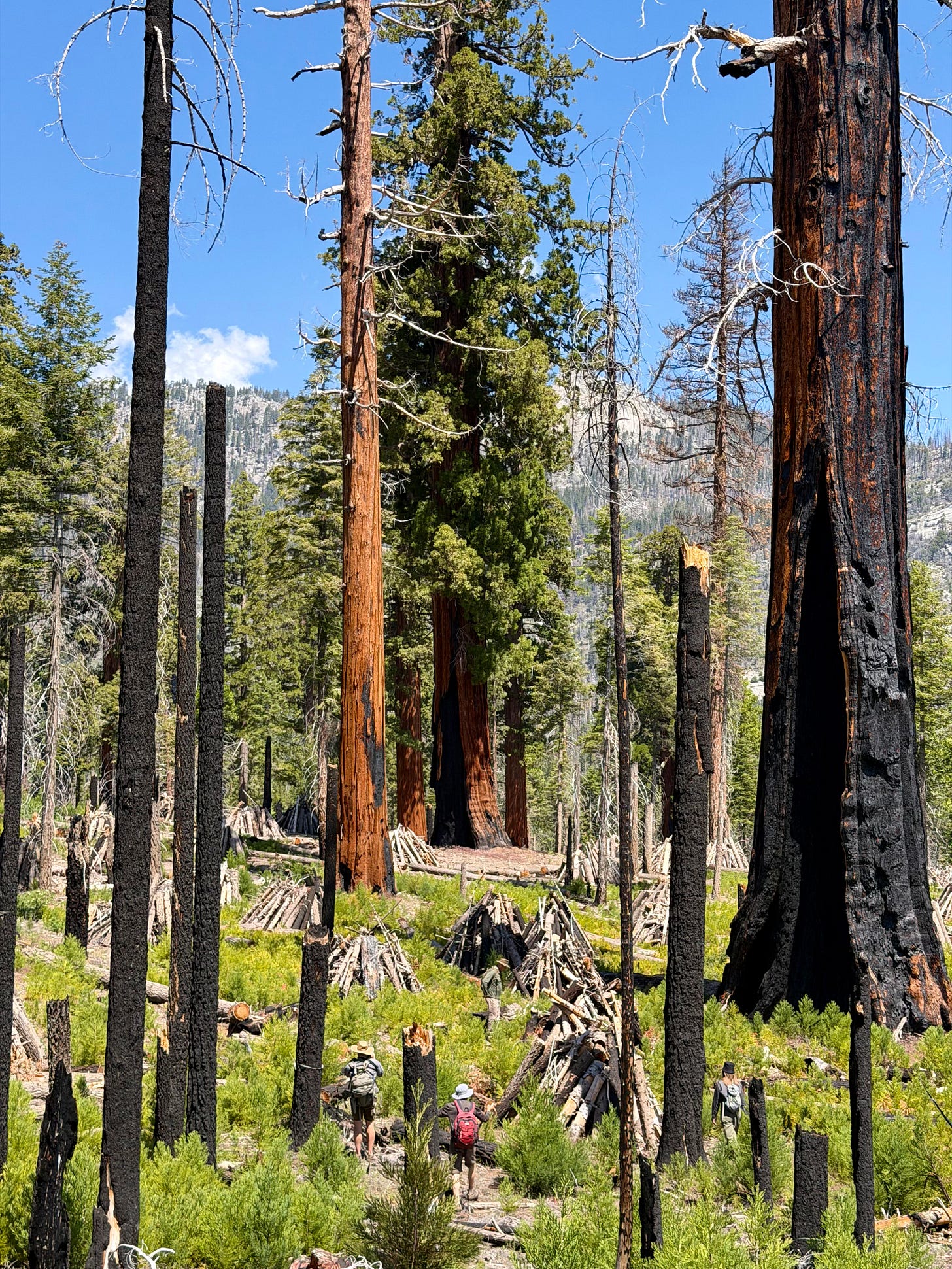
Naturally regenerating giant sequoia seedlings blanket the forest floor beneath surviving old-growth trees — and beneath slash piles left by post-fire logging operations in Freeman Creek Grove, Giant Sequoia National Monument, May 2026 © Nick Scritchfield
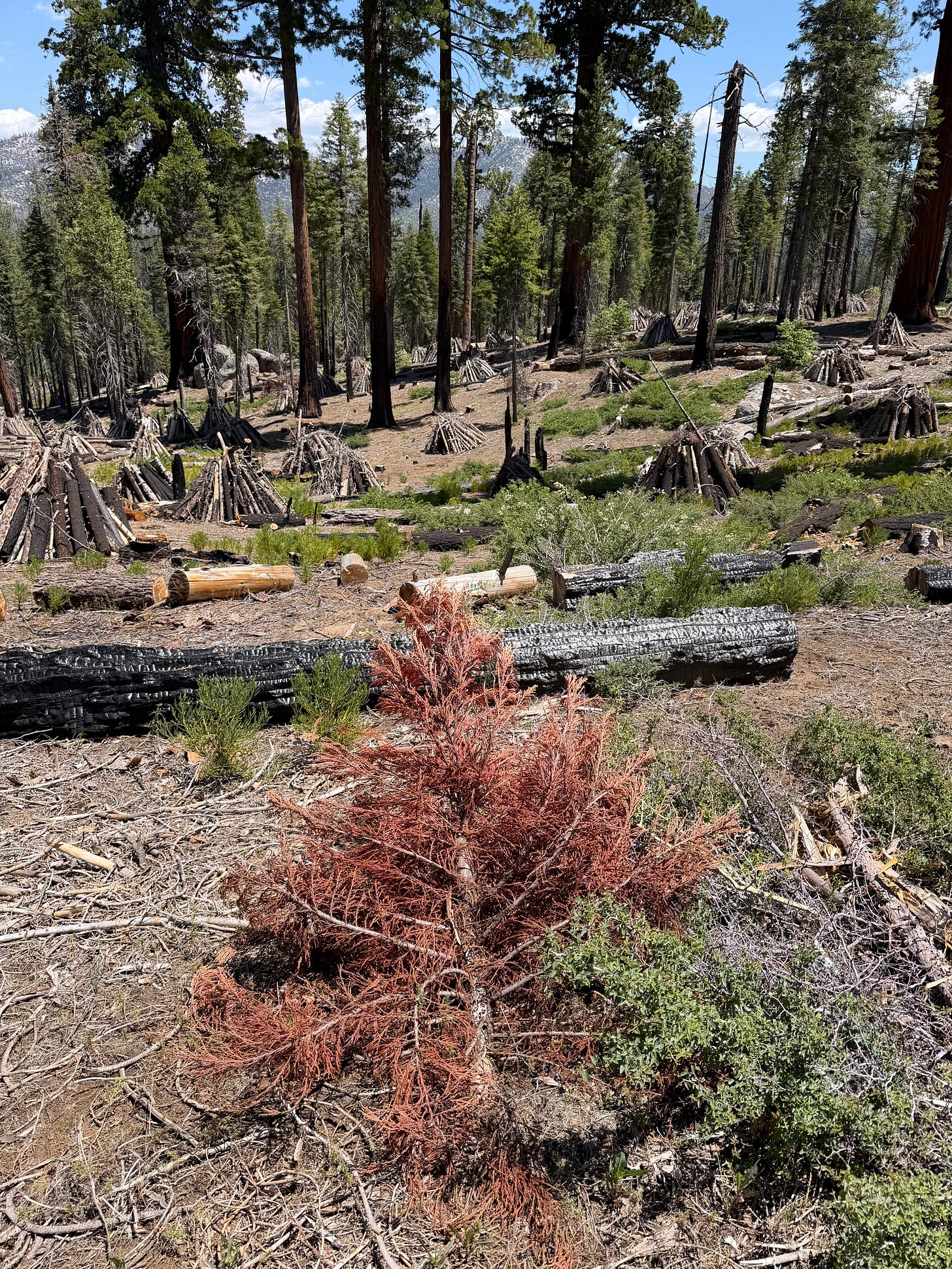
Logging, piling and crashed baby giant sequoias amongst the natural regeneration in Freeman Creek Grove, Giant Sequoia National Monument, May 2026 © Nick Scritchfield
Now the science, because two new studies put numbers to what we have been watching in the field, and several findings directly dismantle claims that have been repeated so often they have achieved the status of received wisdom.
The catastrophic fire narrative has the history backwards; there is now substantially less high-intensity fire across these landscapes. After a prolonged climate-driven period of reduced fire activity, recent increases simply reflect a gradual movement away from the lower end of the historical range of variability. Even where intense fire has become more common, levels remain well below what these landscapes experienced historically and these areas still burn mostly at low- and moderate-intensity. What we are seeing now is not a forest in crisis–it is a dynamic forest rediscovering part of its natural fire regime, a reminder that ecological resilience depends on embracing the entire range of variability these ecosystems evolved with.
Giant sequoia forests can only effectively reproduce after high-intensity fire. That is not a preference. That is an evolutionary dependency. Managing exclusively for lower-intensity fire leads to extreme sequoia regeneration failure and will not maintain viable sequoia populations. Groves being managed toward exclusive low-intensity conditions are, over time, being managed toward extinction. The science is not divided on this. The complication is manufactured by the side with the larger institutional budget and the most to lose if the models are retired — government agencies and industry running predictions and projections contradicting researchers who are on the ground actually counting what is there.
The mortality numbers that have been driving emergency policy: the often-cited claim that 20% of all large sequoias were killed by the 2020 and 2021 fire seasons does not hold up. The actual mortality rate from higher-intensity fire over the entire past century was 14.7%. The natural range before fire suppression, which maintained stable sequoia populations for millennia, was 21.1% to 43.1% per century. The sequoia groves were experiencing in recent wildfires something closer to the range of what they evolved to survive. They built emergency legislation on a misread number, and that legislation — the Save Our Sequoias Act and the Fix Our Forests Act — is still moving.
The natural regeneration in the largest high-intensity fire patch is now more than 21 times denser than agency scientists projected. Where planting was conducted in a Wilderness Area, it accounted for less than half of one percent of what natural regeneration was already producing. The programs consuming significant resources and justifying equipment access to sensitive post-fire areas are, in the most charitable framing, irrelevant.
The surviving large sequoia density within the largest high-intensity fire patch is nearly three times higher than government scientists initially estimated — because they failed to account for epicormic sprouting, the process by which sequoias that initially appear dead produce new green crowns from dormant buds across the crown. Many of the sequoias they counted as lost were not lost. The models did not know to look for what the trees were doing.
And finally: high-intensity fire is unrelated to time-since-fire. The overgrown forests narrative — the one that tells us decades of suppression have loaded these landscapes with extra flammability that now makes fire uniquely dangerous — does not survive contact with the data. That story is a justification in search of a conclusion, and the conclusion was always the cut.
Here is where we land. Fire is not catastrophic unless homes or lives are lost. The images we have been conditioned to receive as images of disaster are, in most cases without direct threat to human communities, images of ecological process. The sequoias pushing twelve feet of new growth through the ash at Freeman Creek are not a recovery story in spite of the fire. They are a recovery story because of it.
What is actually catastrophic is the intervention. The scraped soil at Belknap. The crushed and cut sequoia seedlings at Freeman. The no-notice cuts at Mariposa. The contractor-built bonfires doused in accelerant that bear no resemblance to the fire these landscapes need. The planting schemes that account for less than half a percent of what the forest was already doing on its own.
We know where this goes — and there is no logical stopping point. Fire is too useful as a justification, too legible as a threat, too available as the next emergency. Every fire becomes proof that the previous “management” activity wasn’t enough. Every forest management project degrades the forest’s resilience and guarantees the next fire will be invoked the same way. What remains, over time, is a patchwork of tree plantations and type-converted landscapes that no longer function as the fire-adapted ecosystems they were — produced not by fire, but by the program that claimed to be preventing it.
These sequoia groves do not need management. They need protection from the rogue land management agencies that ignore the science and implement their logging agenda. And they need advocates who understand that the fight is not against one administration — it is against a story that both parties have found useful, and that the forests cannot afford for us to keep believing. The agencies are counting on your fire anxiety to do their work for them. Don’t.
Call your senators today at 202-224-3121. The Senate version of the Farm Bill is reportedly due out any day now — and if it’s anything like the House version, it will likely include two deeply destructive bills: the so-called “Save Our Sequoias Act” (S. 4103) and the so-called “Fix Our Forests Act” (S. 1462). Demand they oppose the inclusion of both. And if that’s what it takes, push for another continuing resolution — there’s no reason to hand this administration another win at the expense of our forests.