
Roundup Was the Symptom. The Intervention Reflex Is the Disease.
The investigation was excellent. The conclusion was industry.
Mother Jones spent a year investigating glyphosate use in national forests, and the results are damning in all the right ways: record spraying, Monsanto-ghostwritten science, a regulatory assessment built on a study that got quietly retracted while the agency kept citing it. If you haven’t read it, you should.
But I watched the video to the end, and something happened in the final few minutes that I haven’t been able to stop thinking about.
Having correctly identified that our national forests are being managed like tree farms — that the Roundup exists to clear the way for commercially valuable conifers — the film’s conclusion pivoted to: our forests don’t need Roundup. They need replanting and thinning.
I understand the impulse. You’ve spent a year documenting institutional failure and you want to hand the audience a solution. But that solution is just Roundup with better PR. It is, in the most precise sense of the phrase, missing the forest for the trees.
Craig Thomas nails the diagnosis: Smokey Bear has a chemical addiction, fostered inside the agency with Monsanto’s help. He’s right. But the rehab he’s prescribing — replanting and “keep the forest thin” — is just a different substance. Same addiction. Logging in the name of natural disturbance, dressed up in captured science, is still logging. A large and diverse body of researchers, including Forest Service scientists themselves, has been saying so for decades, and has been systematically overlooked in favor of the extraction framework.
This is the same agency that adopted Monsanto-ghostwritten science to justify its herbicide program. Baker et al. 2023 documented it in detail for fire science: Forest Service-funded studies systematically omitted the reply literature that refuted their conclusions, creating what the authors called a falsification of the scientific record — a manufactured consensus that historical forests were low-density and low-severity, which happens to justify exactly the logging program the agency financially benefits from. Different product. Same ghostwriter dynamic.
What Fire-Adapted Ecosystems Actually Need
Since time immemorial, fire has not been visiting these forests. It has been making them. The ponderosa pine’s thick bark. The serotinous cone that only opens in heat. The black-backed woodpecker that exists almost exclusively in post-fire snag forest and will not be found anywhere the “restoration” industry has gotten there first. These are not species that tolerate fire. They are species that fire produced, through deep co-evolution with a process that predates every policy, every categorical exclusion, every timber sale.
Post-fire landscapes that can look catastrophic to the human eye — standing dead snags, open canopy, shrub fields exploding with growth — are not moonscapes. They are some of the most biodiverse, productive, and ecologically alive conditions a forest generates. The early successional habitat that follows high-severity fire supports species found almost nowhere else. Natural conifer regeneration, when left alone and given time, happens. Not on our schedule. On the forest’s schedule. Which is the whole problem.
The “forests need replanting” claim is not a neutral ecological observation. It’s a judgment that natural recovery is too slow, too messy, and too uncertain, and that human intervention is the appropriate response. The science does not support this. What interrupts natural recovery, reliably, is salvage logging, which compacts soil, removes the biological legacy that seeds regeneration, spreads invasive species, degrades aquatic habitat through chronic sedimentation, and strips the very conditions the forest was already using to heal itself.
Thinning Is Logging With Better PR
The “thinning reduces fire risk” claim has achieved the status of received wisdom, repeated by agency officials, legislators, influencers, and now apparently investigative journalists looking for a responsible-sounding off-ramp from the Roundup story. Dense, mature forests with high canopy cover consistently show lower fire severity, because closed canopies moderate temperature, retain humidity, and slow wind. Thinning does the opposite: it opens the canopy, dries out the understory, and accelerates wind through the stand. The treatment creates the conditions it claimed to prevent. Forest Service researcher C.M. Countryman documented this in 1956 — the agency has known for seventy years that “thinning” increases fire severity by altering the microclimate, regardless of what is done with the slash.
And let’s be precise about what “thinning” produces: commercially valuable timber. Those involved claim it’s removing “small-diameter” material, but “small-diameter” wood doesn’t pay for the operation — large merchantable trees do. So that’s what gets cut. When the accounting doesn’t work, and it rarely does, the response is never to stop. It’s to lobby for subsidies, new biomass markets, cross-laminated timber incentives — public money chasing a program that loses over $2 billion in taxpayer dollars annually, and that the forest would have handled for free. The pipeline doesn’t end. It rebrands.
Beetle Mania and the Salvage Reflex
Fire isn’t the only disturbance that triggers the intervention impulse. The mountain pine beetle outbreak across western North America, and the massive blowdown left by Hurricane Helene across the Southeast, have both generated the same reflex: log it before it’s “wasted.” The justification is always some version of the matchstick argument: that standing dead trees and downed wood are simply accumulation waiting to ignite, and that leaving them is an act of negligence. It isn’t.
If you’ve ever enjoyed a campfire, you already understand what the matchstick argument gets wrong. Shortly after trees die, the combustible oils in their needles begin to dissipate; within a year, dead needles and twigs fall and begin to decay. Within two or three years, snags are structurally closer to large logs than to kindling, and you cannot put a match to a large log and expect it to burn. Fires do not spread faster in forests with high levels of snags, and bark beetles generally reduce subsequent fire severity, not increase it. What drives extreme fire behavior is wind, humidity, and drought, none of which are addressed by whether the dead trees were logged first.
But each of these disturbances is its own ecological event, with its own succession, its own timing, its own community of species that have co-evolved with exactly these conditions. Beetle kill brings its own cast of species. Blowdown creates its own structural complexity, its own nurse log succession, its own openings. These are not failures. They are the forest doing what it has always done with stress: metabolizing it, on its own timeline, into something alive. Conservation North’s Life After Disturbance poster series documents exactly what these landscapes become when left alone. It’s worth your time.
Salvage logging doesn’t distinguish between any of them. It moves in with the same equipment, the same contracts, the same justification, and dismantles processes that were already underway. The carbon math is damning: logging in U.S. forests emits ten times more carbon than wildfire and native insects combined. And logging before or after any disturbance consistently results in more dead trees than the disturbance alone would have produced. The intervention doesn’t reduce mortality. It adds to it.
Disturbance is not damage. The salvage operation is.
The Accountability Question Nobody’s Asking
Here is what I find most striking about the replant-and-thin conclusion, and about most of the mainstream wildfire conversation: the proposed remedies never implicate the humans.
We have built hundreds of thousands of homes in fire-prone landscapes, with flammable roofing materials, flammable decks, flammable landscaping, under flammable utility lines. We are systematically destabilizing the climate through the burning of fossil fuels, making fire weather more frequent, more intense, and longer in duration. We cause more than 84% of ignitions. And then we look at the forest — the thing that has been doing this since time immemorial without our help — and we decide it needs surgery.
A few summers ago, documenting a thinning project on the Roosevelt National Forest in Colorado, someone noticed my concern and asked if I didn’t think this was making the community safer. I asked whether they’d taken any personal precautions — home hardening, defensible space pruning. They scoffed. Why would they, when this was supposed to handle it. That exchange is the whole problem in one conversation.
Whether a structure survives a wildfire is determined almost entirely by conditions within roughly 100 feet of the building: the roofline, the vents, the deck boards, the five feet adjacent to the foundation. Not the ridge five miles away. Not the stand logged three years ago. And yet we keep building the same structures back into the same landscapes after they burn, under pressure to rebuild fast that reliably beats any pressure to rebuild better.
Then there is the infrastructure nobody wants to talk about. Investor-owned utilities have spent decades lobbying against undergrounding requirements, against accountability for transmission line maintenance, and against the kind of distributed generation — rooftop solar, community microgrids, locally owned co-ops — that would reduce both transmission line sprawl and the monopoly incentive to defer maintenance. Utility infrastructure accounts for less than 10% of wildfires but roughly half of the most destructive ones in California history. Camp. Dixie. Thomas. Woolsey. Their alternative to undergrounding — clearing fire-adapted native shrubs and trees in ever-widening corridors — replaces fire-resistant vegetation with the highly flammable grasses that carry surface fire and feed the ember cast that actually kills communities. The business model that concentrates profit and socializes risk is still intact.
This is where the evidence points: hardening structures, creating defensible space pruning at the parcel level, breaking the utility monopoly model that has turned transmission infrastructure into a reliable ignition source. Earlier this spring in Colorado, a bill that would have begun doing exactly this was killed in committee. “Conservation” organizations testified against it, standing alongside industry and government logging interests to oppose redirecting any “mitigation” dollars away from logging public forests and toward the homes of the people they claim to protect. That is not a conservation position. That is a market position — from the same nonprofit infrastructure that has spent decades manufacturing consensus around managed logging frameworks and defaming researchers who point to contrary evidence, presenting the result as settled science. Which is why the forest keeps getting logged and the houses keep burning.
The Ending the Documentary Couldn’t Give You
The Roundup story is a symptom of something larger than Monsanto’s lobbying operation or one agency’s regulatory capture. It is a symptom of a civilization that has decided, at every turn, that the appropriate response to a natural process is a managed one — that disturbance is damage, that recovery requires intervention, that the forest left alone is the forest wasted.
Forests touched by fire, beetle, blowdown, or drought are not waiting for our help. They are already doing something complex, something timed to cues we don’t fully understand, something that produces conditions found almost nowhere else. What interrupts that process, every time, is us.
The problem is bigger than replant and thin. The intervention reflex leads to the building codes we won’t update and won’t enforce when we rebuild, the utility corridors we won’t underground, the homes we keep building in places that will burn, and the money we keep spending on the wrong thing — because intervention has contracts, budgets, and an endless scroll of carefully curated imagery and industry-funded science designed to foreclose the conversation before it starts, and restraint has none of those things.
Get out of the way. Stop poisoning the path back. And when the next documentary ends with a call to replant the forest, ask who benefits from the replanting.
If you made it this far: call your representatives. HR 582 and S 3609, the Community Protection and Wildfire Resilience Act, would direct up to $1 billion annually toward home hardening, defensible space pruning, and evacuation planning — the things that actually keep communities alive. It’s bipartisan. It needs pressure. The Capitol switchboard is 202-224-3121.
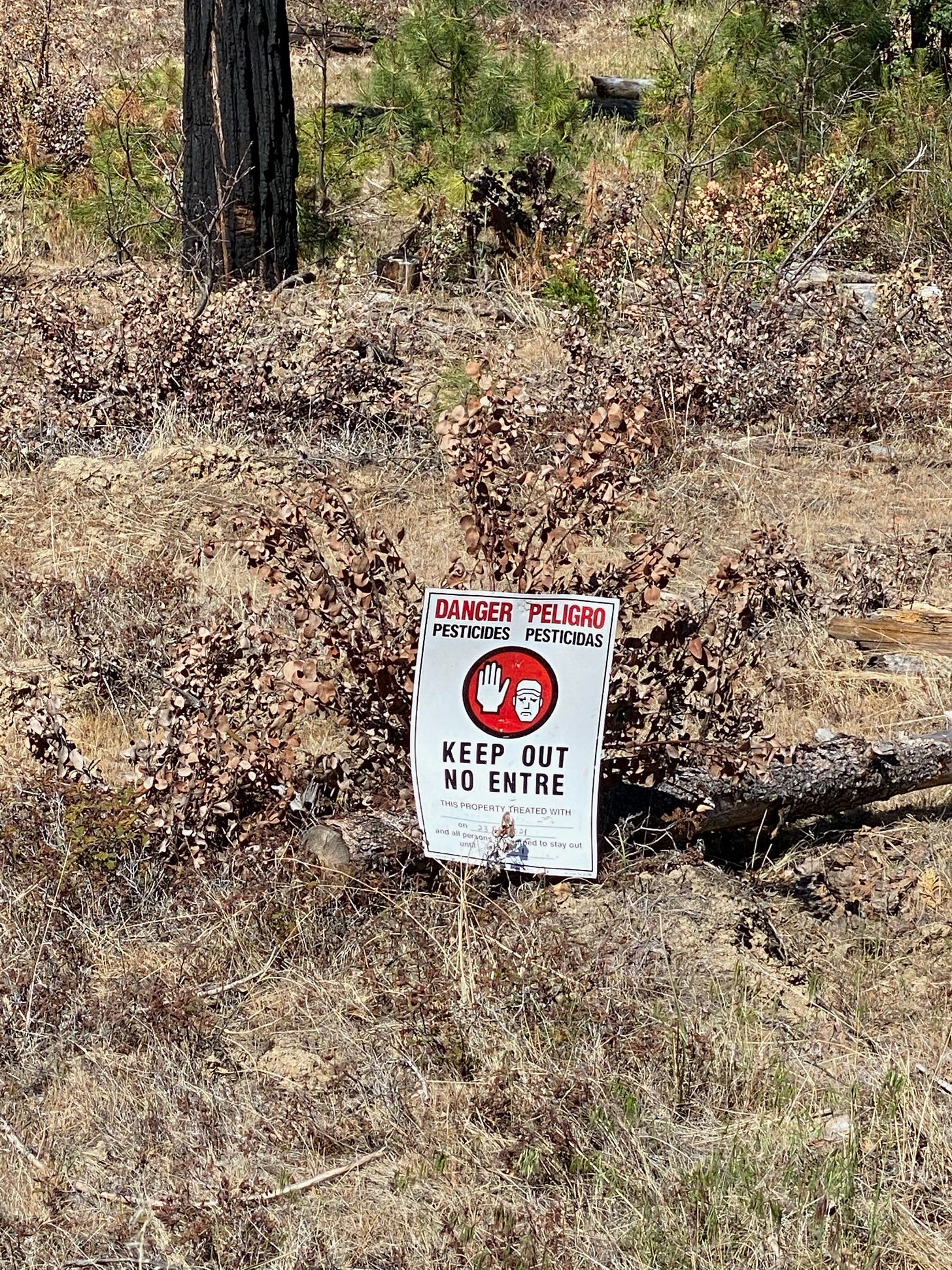
Rim Fire, Stanislaus National Forest, California, June 2021 © Jennifer Mamola
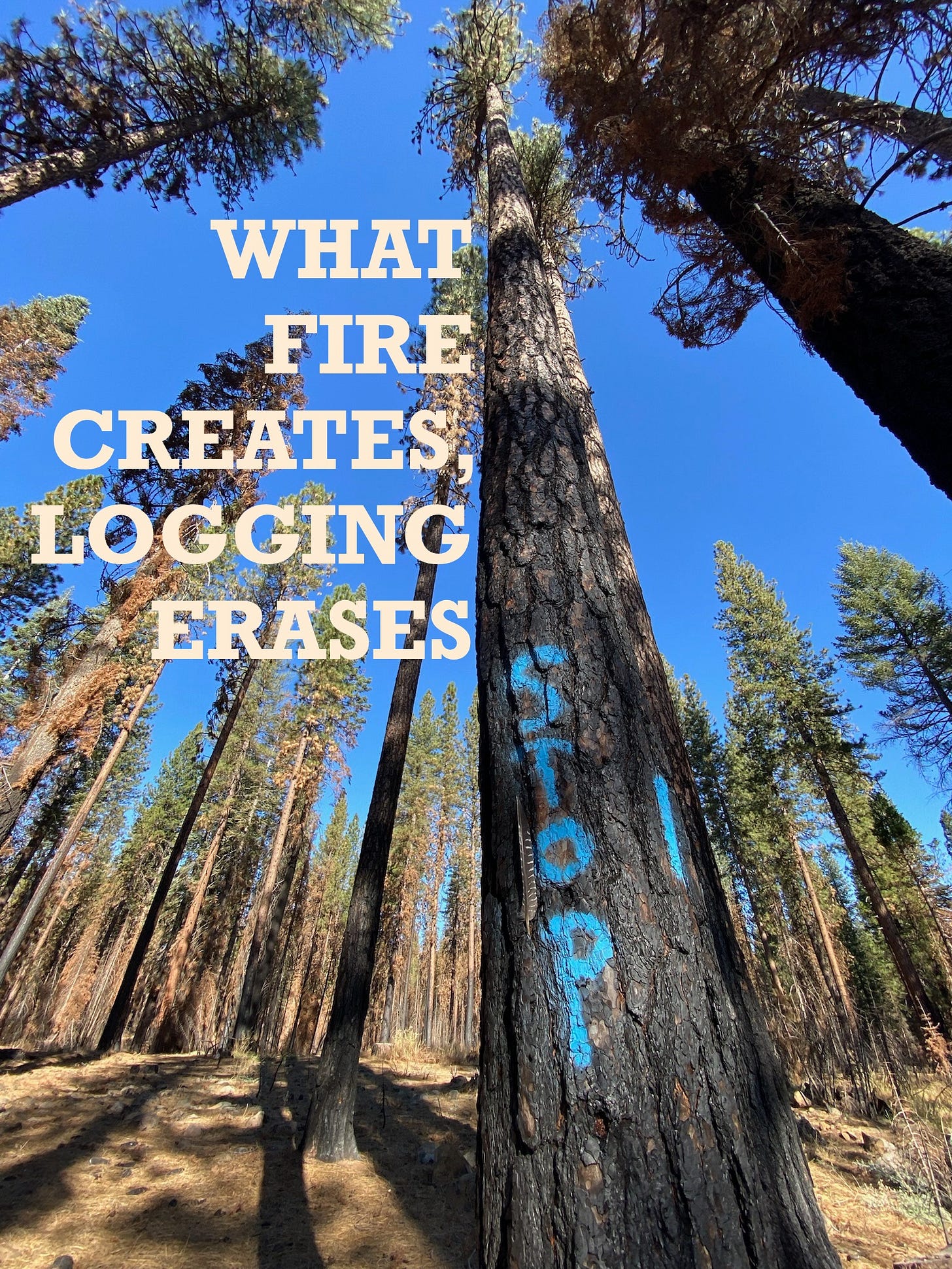
Dixie Fire, Lassen National Forest, October 2022 © Jennifer Mamola
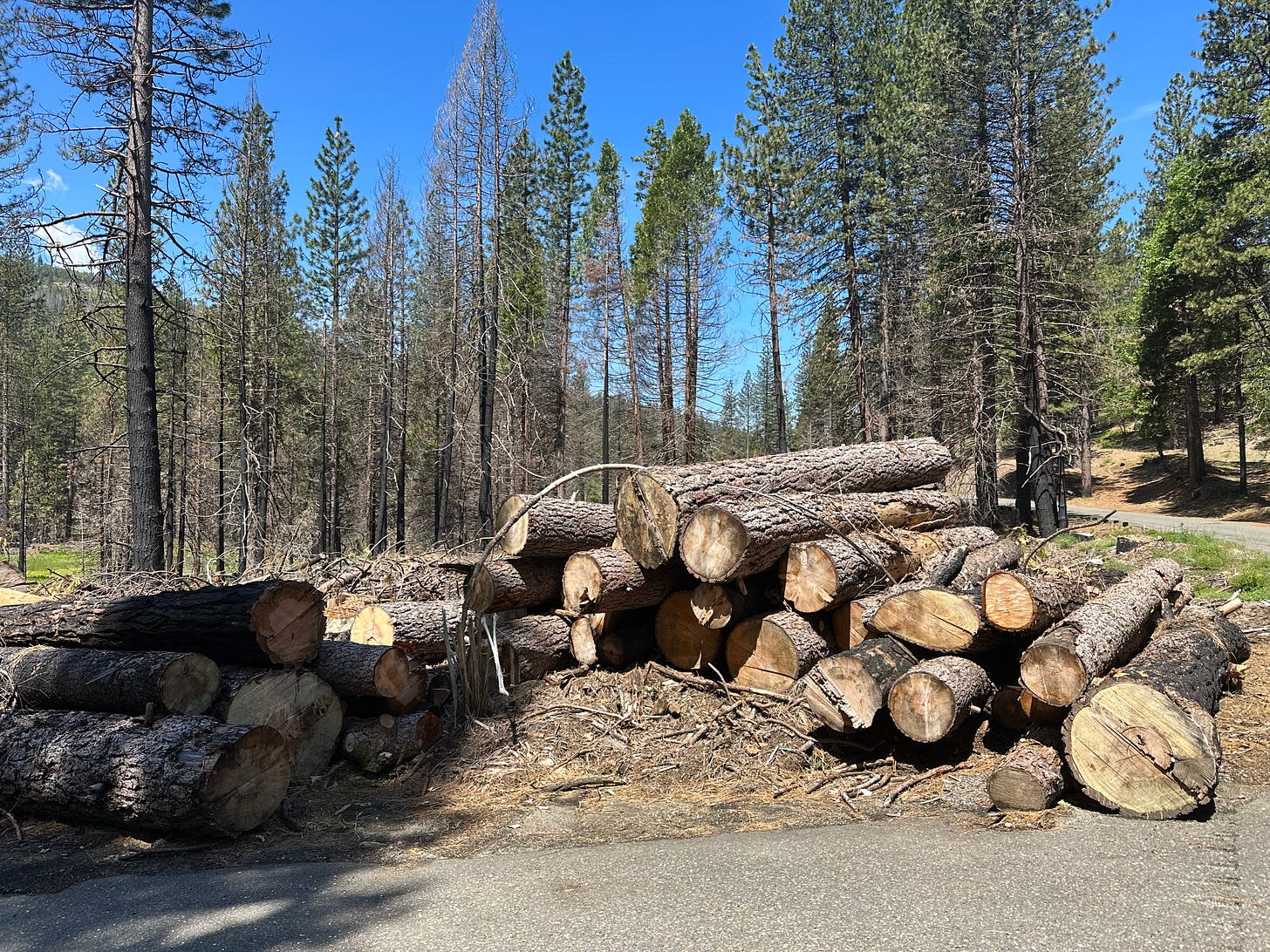
Caldor Fire Salvage Logging, El Dorado National Forest, June 2023 © Jennifer Mamola